
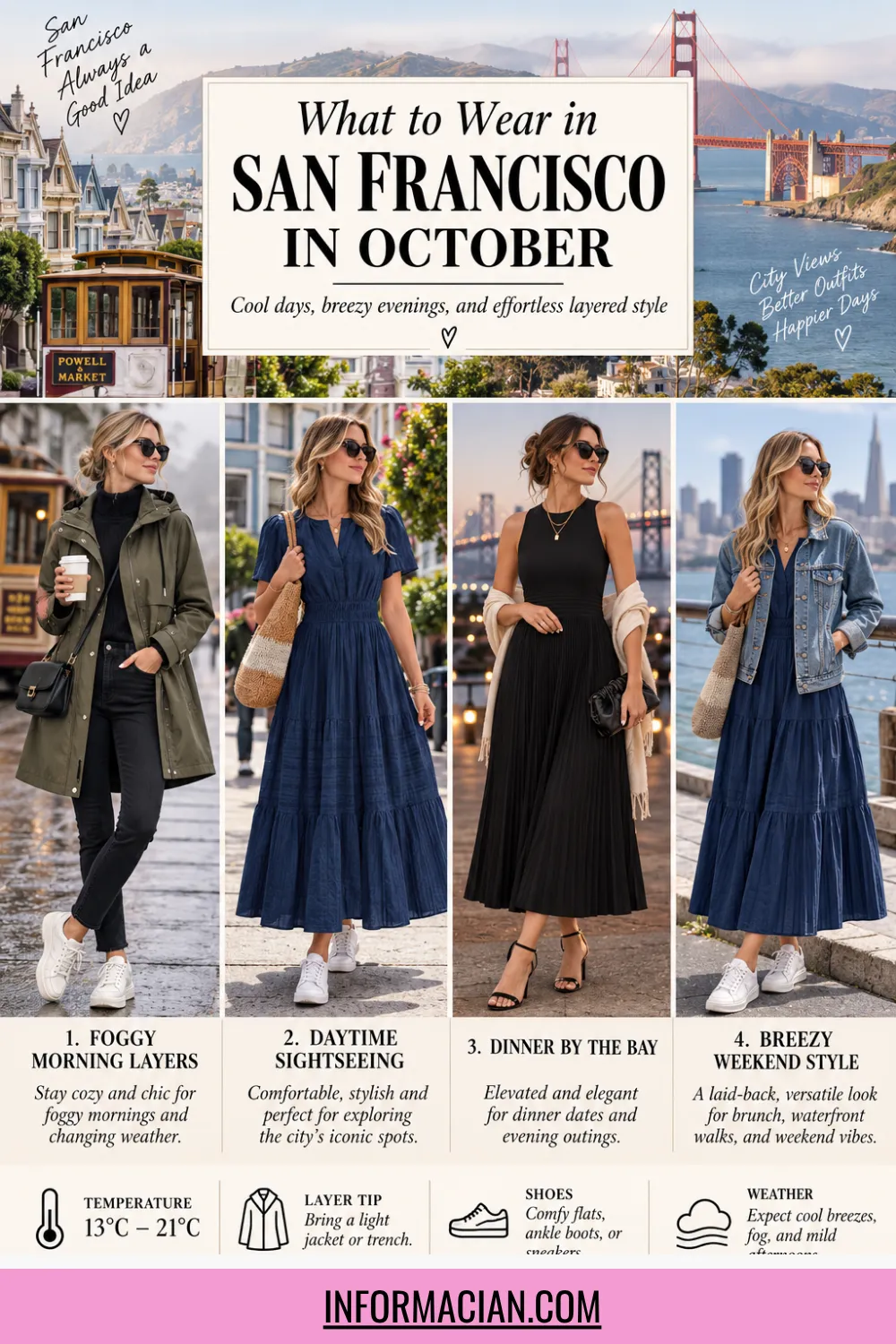
Let me be honest — San Francisco in October broke my packing brain the first time I visited. I checked the forecast before I left, saw 68°F, and packed like it was a mild autumn day. Then I stepped outside at 7am into a fog so thick I could barely see the end of the block, wearing a T-shirt, shivering, wondering if I’d somehow flown into the wrong city.
This is the thing nobody tells you about San Francisco in October: it’s actually one of the best months to visit — warm, golden, often the sunniest stretch of the whole year — but the weather changes so fast within a single day that “what to wear” isn’t really about the season at all. It’s about layers, and about accepting that you’ll adjust your outfit more times before noon than you would in a week anywhere else.
If you’re the kind of traveller who packs one outfit per day and calls it done, San Francisco is going to test you. But once you understand the rhythm of the fog and the sun, dressing here gets almost fun — it’s less about “autumn style” and more about building a small, flexible system that survives four microclimates before lunch.
Before We Dive In
October in San Francisco is often called part of the city’s unofficial “second summer” — locals genuinely look forward to it because it’s usually warmer and sunnier than the actual summer months, when fog blankets the coast for weeks at a time. Daytime highs typically sit in the mid-60s to low 70s°F, occasionally pushing into the high 70s during a proper Indian summer stretch. Mornings and evenings, though, drop into the 50s, and the marine fog can roll in fast, especially near the coast, the Presidio, or anywhere close to the Golden Gate Bridge.
Walking conditions here are no joke — San Francisco is a city built on actual hills, not gentle inclines. You’ll be climbing real grades in neighbourhoods like Nob Hill or Russian Hill, navigating uneven sidewalks in older areas, and possibly getting rained on if a system rolls through (rain is rare in October but not impossible toward the end of the month). Comfortable shoes aren’t optional here; they’re the whole game.
Style-wise, San Francisco leans understated and layered rather than flashy. You won’t stand out in jeans and a good jacket, but you also won’t blend in wearing shorts and flip-flops downtown — this isn’t a beach town, even on a warm day. Think smart-casual with room to add or remove layers, and you’re dressed right for almost anywhere in the city.
A Lightweight Base Layer (Your Actual Foundation)
This surprised me on my first trip — how much the whole outfit depends on what’s underneath the jacket, not the jacket itself.
Because temperatures swing 15-20 degrees between a foggy morning and a sunny afternoon, your base layer needs to work alone in direct sun and comfortably under a jacket in the shade.
A simple long-sleeve tee, a lightweight sweater, or a breathable button-down all do this well — cotton or a cotton-blend that won’t feel clammy if you warm up climbing a hill in Pacific Heights.

A morning look might be a long-sleeve tee under a jacket for the fog-heavy walk to breakfast; by 1pm in Dolores Park with the sun fully out, you’ve shed the jacket and you’re comfortable in just the tee. That flexibility is the whole point.

Local tip: Skip anything too thin or too warm — you want a layer that’s genuinely comfortable on its own, not one that only works as insulation.
The Layer That Does All the Work: A Mid-Weight Jacket
If you remember one thing from this whole article, let it be this: bring a real jacket, not a cardigan, and don’t leave it in the hotel room “just in case.”
San Francisco fog isn’t decorative — it carries real, damp cold, especially near the water or in neighborhoods like the Sunset or Richmond District.
A mid-weight jacket (a denim jacket, a light bomber, a wool-blend coat) that can handle 50°F mornings and be tied around your waist by 2pm when the sun burns through is the single most useful item you’ll pack. Mark Twain never actually said the famous “coldest winter I ever spent” line about San Francisco summer, but whoever did understand the vibe was onto something — that same logic applies to October mornings too.

I wore the same olive utility jacket every single day on my last trip — over a dress for dinner, over a tee at the pier, unzipped and flapping while I hiked up to Coit Tower. One good jacket beats three mediocre ones.

Local tip: A packable puffer works surprisingly well here too if you’re visiting Twin Peaks or anywhere elevated — it gets noticeably colder and windier at altitude.
Jeans (Still the MVP, Even in October)
This one felt obvious walking in, and it turned out to be exactly right — jeans are doing more work in San Francisco than in almost any other city I’ve packed for.
A good pair of jeans handles the temperature swing better than most fabrics: breathable enough for a 70°F afternoon, substantial enough to block the wind on a foggy hill climb. Pair them with sneakers and a jacket for daytime exploring, or dress them up with boots and a blouse for dinner in the Mission.

I’d bring two pairs max — one slightly more polished pair for dinners, one broken-in pair you don’t mind hiking hills in all day.

Local tip: Dark wash jeans hide the inevitable fog mist and city grime better than lighter denim — useful on a day spent walking the Embarcadero.
Comfortable Walking Shoes (Non-Negotiable Here)
I learned this the hard way, nursing sore feet after underestimating just how steep San Francisco’s hills actually are on day one.
This city will humble any shoe that isn’t built for real walking — supportive sneakers, broken-in leather boots, or a well-cushioned flat all work, but anything stiff or unbroken-in will wreck you by early afternoon. Streets like Lombard, Filbert, or the climb to Alamo Square aren’t casual strolls; they’re genuine inclines that make you grateful for good arch support.

For a day of sightseeing, sneakers are the obvious pick. For an evening out, a low block-heel boot or a clean leather sneaker works fine — San Francisco doesn’t really do “dress shoes only” venues.

Local tip: Break in any new shoes before you land — the hills will find every weak spot in a stiff pair within the first hour.
A Scarf (More Useful Than It Sounds)
It sounds like a small accessory, but a scarf pulled its weight more than almost anything else I packed.
A midweight scarf works as an extra layer around fog-chilled mornings, doubles as a light wrap if the wind picks up on a ferry to Alcatraz, and can be tucked away in a bag the moment the sun actually comes out. Unlike a full extra layer, it takes up almost no suitcase space and adjusts instantly to how cold you actually feel.

I wrapped mine around my neck on the ferry over to Sausalito and was very glad for it — the bay gets genuinely windy in a way the forecast doesn’t fully capture.
Local tip: A scarf in a neutral, muted color works with basically every other layer you bring, so you’re not overthinking coordination each morning.
One Dressier Outfit for Dinner
You don’t need much here, but San Francisco does have a handful of restaurants — especially around Hayes Valley or the Financial District — where showing up in hiking gear feels slightly out of place.
A simple dark dress or trousers with a nice top, paired with the same jacket you’ve been wearing all day, is more than enough. The city’s food scene leans toward relaxed-but-considered rather than formal, so nobody expects heels or a blazer — just something a notch more put-together than daytime wandering clothes.

I wore a black wrap dress with ankle boots and my everyday jacket to two different dinners on one trip, and it worked for both a casual noodle spot and a slightly nicer wine bar.

Local tip: Keep the dinner outfit adjustable — a dress you can layer the same jacket over means you’re not carrying a second coat just for the evening.
Rain Gear (Pack It Even Though You Probably Won’t Need It)
This surprised me — October is mostly dry, but the tail end of the month can bring the season’s first real rain, and San Francisco doesn’t do gentle drizzle so much as sudden, wind-driven showers.
A packable rain shell or a compact umbrella takes up almost no space and saves you from either buying an overpriced tourist umbrella or getting soaked walking between Union Square and your hotel. Because rain here tends to arrive with wind, a jacket with a hood actually outperforms an umbrella most of the time — you’ll spend less energy fighting it inside out.

Local tip: Check the specific week you’re traveling — early October is almost always dry, while late October starts to flirt with the first storms of the wet season.
Sunglasses and a Light Hat
Locals joke about “second summer” for a reason — when the fog burns off, San Francisco sun is genuinely strong, especially reflecting off the bay near the Embarcadero or Crissy Field.

A good pair of sunglasses earns its keep on clear afternoons, and a light, packable hat helps on longer outdoor stretches like a walk across the Golden Gate Bridge, where there’s little shade and often more wind than you’d expect. Neither needs to be fancy — just genuinely useful rather than purely decorative.

Local tip: Keep sunglasses in an easy-access pocket rather than buried in your bag — you’ll be putting them on and taking them off constantly as the fog rolls in and out.
A Crossbody Bag or Small Backpack
Not clothing exactly, but it belongs here because the wrong bag makes hill-walking miserable fast.
A crossbody bag or a slim backpack that sits securely and doesn’t bounce around is worth prioritising over a stylish tote you’ll be readjusting every ten minutes. San Francisco’s neighbourhoods invite a lot of walking between stops, so anything heavy or awkward on one shoulder becomes a real annoyance by the third hill.

Local tip: Leave valuables genuinely out of sight in this bag, especially around tourist-heavy spots like Fisherman’s Wharf — petty theft from cars and bags is a known local issue.
What Not to Wear
If you’re coming from a warmer-weather city, the biggest mistake is trusting the daytime high on the forecast and packing shorts and sandals as your main plan — you’ll be cold by 8am and again by 6pm, even on the warmest October days.
Skip heavy winter coats too; despite the fog, this isn’t cold-weather territory, and a full parka will have you overheating the second the sun comes out.
And go easy on anything that can’t handle a real hill — stiff dress shoes, flowing maxi skirts that catch the wind on a bridge walk, or anything you’d be annoyed to carry if you needed to shed it fast.
If you want a broader, more general take on building a flexible travel wardrobe rather than a city-specific one, this packing capsule breakdown covers the same layering logic that works here, just built around warmer climates.
How Many Outfits to Actually Pack
For a long weekend, I’d bring three jacket-friendly base outfits, one dinner outfit, and let the accessories — scarf, jacket, sunglasses — do the real adapting day to day. Packing light works better here than almost anywhere else I’ve traveled, purely because you’re re-wearing the same jacket and jeans combo constantly and just swapping the base layer underneath.
The biggest mistake is overpacking for “worst case cold” and underpacking for “actually pretty warm afternoon.” San Francisco rewards flexible pieces over a big rotating wardrobe — a capsule of five or six items that layer well will get you further than fifteen separate outfits. If you want the mechanics of packing that kind of trip efficiently, this guide to packing a carry-on for ten days walks through building exactly this kind of adaptable rotation.
San Francisco doesn’t ask you to dress for a season — it asks you to dress for a single day that somehow contains four of them. Once you stop fighting that and just bring the layers, the city stops feeling unpredictable and starts feeling like the best kind of packing puzzle: the one where a scarf, a good jacket, and broken-in shoes solve almost everything the fog throws at you.


One Response