
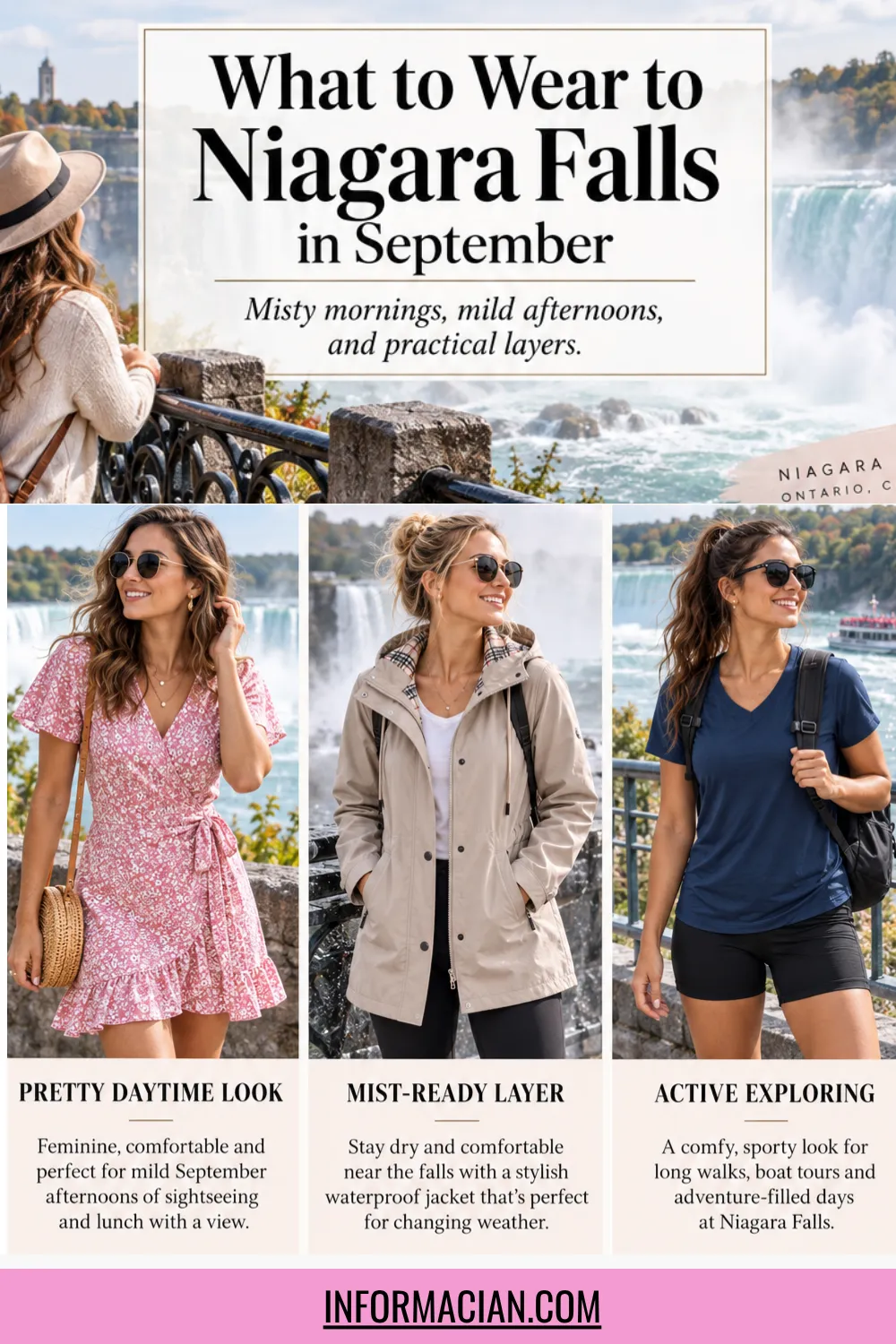
Let me be honest — nothing humbles an outfit faster than standing on the Maid of the Mist deck and realizing your “cute travel look” is now soaked through and clinging to you in a way you did not plan for. Niagara Falls in September doesn’t care how put-together you look on the walk over.
This is one of the best months to visit, honestly — the summer crowds thin out, the light turns gold in the afternoons, and the temperature sits in that sweet spot where you’re not sweating through a t-shirt or shivering in a parka. But September here is also a month of two very different days stacked into one: crisp, almost autumn-cool mornings, and warm, still-summer afternoons, with a constant fine mist rolling off the falls no matter what the sky is doing.
If you’re used to packing for a single “vacation vibe,” Niagara Falls will ask you to rethink that. This isn’t a beach trip and it isn’t a proper fall foliage trip either — it’s somewhere in between, with water spray added to every outdoor plan. Here’s what actually earns a spot in your bag.
Before We Dive In
September temperatures around Niagara Falls typically run from the high 50s°F in the early morning up to the low-to-mid 70s°F by mid-afternoon, with the lake-effect air keeping things noticeably cooler and breezier right at the water’s edge than a few blocks back in town. Rain shows up more as short, scattered showers than all-day soakers, but the falls themselves generate their own weather — a steady mist that drifts depending on wind direction and can catch you off guard even on a clear, sunny day.
Walking conditions matter here in a specific way most people don’t expect: the paths along the Niagara Parkway and around the observation decks get genuinely slick from spray, especially near Table Rock and the Journey Behind the Falls area. You’re not dealing with cobblestones so much as wet railings, damp pavement, and stairs that demand actual grip underfoot.
Style culture here is relaxed by design — this is a destination built around walking, viewing platforms, and boat tours, not a place that expects polished outfits. That said, there’s a real difference between “comfortable tourist” and “looks like they got dressed in the dark,” and a few smart choices bridge that gap without much effort.
A Genuinely Waterproof Jacket (Not Just Water-Resistant)
This surprised me the first time — I brought a light “water-resistant” windbreaker thinking it would handle the mist fine, and it was soaked through in about four minutes at the base of the falls.
The difference between water-resistant and truly waterproof matters enormously here, because you’re not just dealing with occasional rain — you’re dealing with a fine, near-constant spray that finds its way into anything not properly sealed. A real waterproof shell, ideally with a hood, keeps you dry on the boat tours, at the observation decks, and walking the Parkway on a windy day when the mist blows sideways.

For a morning at Table Rock, this jacket over a base layer is really the whole outfit; for dinner later, you can trade it for something lighter since you’ll be well away from the spray zone by then.
Local tip: The included ponchos on the Hornblower and Maid of the Mist boat tours help, but they don’t fully protect your shoes or the hem of your pants — plan your footwear with that in mind too.
Quick-Dry Layers Under Everything
I learned this the hard way after wearing a cotton hoodie on my first Journey Behind the Falls visit — it took the rest of the day to properly dry out, and I spent hours feeling damp and a little cold.
Cotton holds onto moisture and stays clammy for hours once it’s wet, which is exactly the wrong quality for a destination built around water spray. Synthetic or synthetic-blend base layers — a simple quick-dry tee or a light athletic long-sleeve — dry out fast if you get misted, and layer comfortably under the waterproof shell when the morning air is cool.

A practical combo: quick-dry tee, waterproof jacket over top, jeans or quick-dry pants below, ready for anything from a boat tour to an afternoon walk along the gorge.

Local tip: Pack an extra quick-dry layer in your day bag if you’re doing both a boat tour and Journey Behind the Falls in the same day — you’ll likely want a dry one for round two.
Jeans or Quick-Dry Pants (Skip the Delicate Fabrics)
This one felt obvious once I saw it in action — a woman in flowing linen trousers ahead of me on the Skylon Tower deck had them plastered to her legs within minutes of stepping outside.
Sturdy, quick-drying fabrics beat anything delicate or slow to dry here. Jeans handle the mist reasonably well and dry out during a warm afternoon; technical hiking-style pants dry even faster and add a bit more mobility for longer walks along the gorge trails. Either works better than linen, silk, or anything with a loose, breezy cut that soaks up spray and clings uncomfortably.

For a full day combining the falls, a boat tour, and a walk through Queen Victoria Park, jeans with sneakers is the reliable, no-regrets choice.

Local tip: Roll your cuffs slightly if you’re walking close to the railings on a misty day — ankle-level splashback is more common than people expect.
Comfortable, Grippy Walking Shoes
I nearly wiped out on the observation deck steps in a pair of smooth-soled sneakers, and that was the moment I understood why “comfortable shoes” isn’t just generic travel advice here — it’s a safety issue.
Wet pavement and slick railings near the falls call for shoes with real tread, not just cushioning. A supportive sneaker or a light trail shoe with decent grip handles the walk from Clifton Hill down to the falls, the boat tour docks, and the sometimes-slippery paths through the parkway far better than anything smooth-soled or open-toed.

For a full day of sightseeing, grippy sneakers are non-negotiable; for an evening out at one of the casino restaurants, a clean pair of low boots or smart sneakers works fine without sacrificing comfort.

Local tip: Avoid brand-new shoes for this trip specifically — wet conditions expose blister spots faster than dry sidewalks do.
A Packable Layer for the Morning Chill
This surprised me on my first September visit — I underestimated just how cool it gets right at sunrise near the water, even though the afternoon ended up genuinely warm.
A packable fleece or lightweight puffer that folds down small is worth carrying even if you don’t think you’ll need it. Mornings at the falls, especially if you’re catching the sunrise crowds before the tour boats start running, sit noticeably cooler than the forecast high suggests, and the breeze off the gorge adds a real chill factor that a t-shirt alone won’t handle.

I wore mine under the waterproof shell for an early walk to Table Rock, then stuffed it in my bag by 11am when the sun burned through and the day warmed up properly.
Local tip: If you’re planning a sunrise or sunset viewing specifically, add this layer even if the daytime high looks mild — the temperature drop right at the water’s edge is sharper than you’d expect.
Footwear and Outfit for the Boat Tours
Here’s something nobody mentions until you’re standing in line soaked: the boat tours provide ponchos, but what you wear underneath and on your feet still matters enormously.
Closed-toe shoes you don’t mind getting a little wet are the move here — flip-flops and sandals leave your feet exposed to spray with no real payoff, and slippery boat decks are not the place for anything without grip. Under the provided poncho, quick-dry layers again do the heavy lifting, since ponchos cover your torso but rarely seal completely at the neck or wrists.

A practical outfit: quick-dry tee, jeans, sneakers, poncho on top, hair tied back or under a cap — you’ll be glad you didn’t wear anything precious.

Local tip: Skip carrying an umbrella onto the boat — the wind off the falls will turn it inside out within seconds, and it’s genuinely more hassle than it’s worth.
One Slightly Dressier Outfit for Evenings
You don’t need much here — Niagara Falls leans casual overall — but there’s usually one evening, especially if you’re near the Fallsview casino district, that calls for something a touch more put-together.
A simple dress or button-down with dark jeans, paired with clean shoes instead of your day’s sneakers, covers most of the nicer restaurants in the area without feeling overdressed or underdressed. The vibe here trends toward “smart casual,” not black-tie — nobody’s expecting heels or a blazer, just something that isn’t damp from the falls.

I wore a simple wrap dress with ankle boots and a light cardigan to dinner overlooking the falls at night, and it worked perfectly without needing anything fussy.

Local tip: If your hotel room has a view of the falls lit up at night, plan one evening around that — worth dressing slightly nicer for the photos even if you’re just staying in for dinner.
A Crossbody Bag or Small Waterproof Backpack
Not clothing exactly, but it earns a spot here because the wrong bag turns a misty day into a genuinely damp, uncomfortable one.
A crossbody bag with a flap closure, or a small backpack with a rain cover, keeps your phone, wallet, and any extra layers dry through the boat tours and the walk along the gorge. A tote or an open-top bag is the wrong call here — spray finds its way into anything uncovered surprisingly fast.

Local tip: A gallon ziplock bag inside your daypack is a cheap, unglamorous backup for your phone specifically — worth the extra few grams of weight.
Sunglasses and a Cap (Even on Cloudy Days)
It sounds like a small thing, but the light bouncing off the water and mist here creates a surprising amount of glare, even under overcast skies.
A cap works double duty — cutting glare and keeping mist out of your eyes on the observation decks — while sunglasses help on the clearer, sunnier September afternoons when the light off the gorge gets genuinely bright. Neither needs to be anything special, just something you don’t mind getting a little damp.

Local tip: Choose a cap over anything wide-brimmed — wide brims catch wind unpredictably close to the falls and tend to fly off at the worst moments.
What Not to Wear
The biggest mistake I see, and made myself early on, is trusting a warm forecast and packing like it’s a beach trip — shorts and sandals feel fine at 2pm, then genuinely uncomfortable by 8am and again once the mist picks up near the falls.
Skip anything made of suede or delicate leather, since spray and damp pavement will mark it up fast. Avoid flowing skirts or wide-leg linen pants too — they catch wind at the railings and cling uncomfortably once wet. And leave anything you’d be genuinely upset to ruin at home; Niagara Falls has a way of finding the one item in your suitcase you actually cared about.
If you’re building out a broader travel wardrobe strategy rather than a destination-specific one, this guide to packing tips and hacks that actually work covers a lot of the same layering logic that applies here, just written for general use.
How Many Outfits to Pack
For a long weekend, three day outfits built around the same waterproof jacket, one dressier evening outfit, and a spare quick-dry layer for after a boat tour or Journey Behind the Falls is realistic and comfortable. The falls genuinely reward re-wearing the same reliable jacket and shoes rather than packing a fresh look for every single day — you’ll be grateful for one waterproof layer you trust over three cute jackets that all fail differently in the mist.
The most common mistake is overpacking for a generic “fall trip” — heavy sweaters, wool coats, boots that aren’t built for wet pavement — when what actually works here is lighter, quicker-drying, and more weather-flexible. If you want the mechanics of building that kind of adaptable, lightweight rotation for a short trip, this carry-on packing guide breaks down exactly that approach, even though it’s framed around a longer trip.
Niagara Falls has a way of humbling even the most carefully planned outfit, and honestly, that’s part of the charm. Once you stop trying to stay pristine and just pack for the mist instead of against it, the whole trip gets easier — you stand closer to the railing, you don’t flinch at the spray, and you end up with better photos because you’re not busy worrying about your shoes.

