
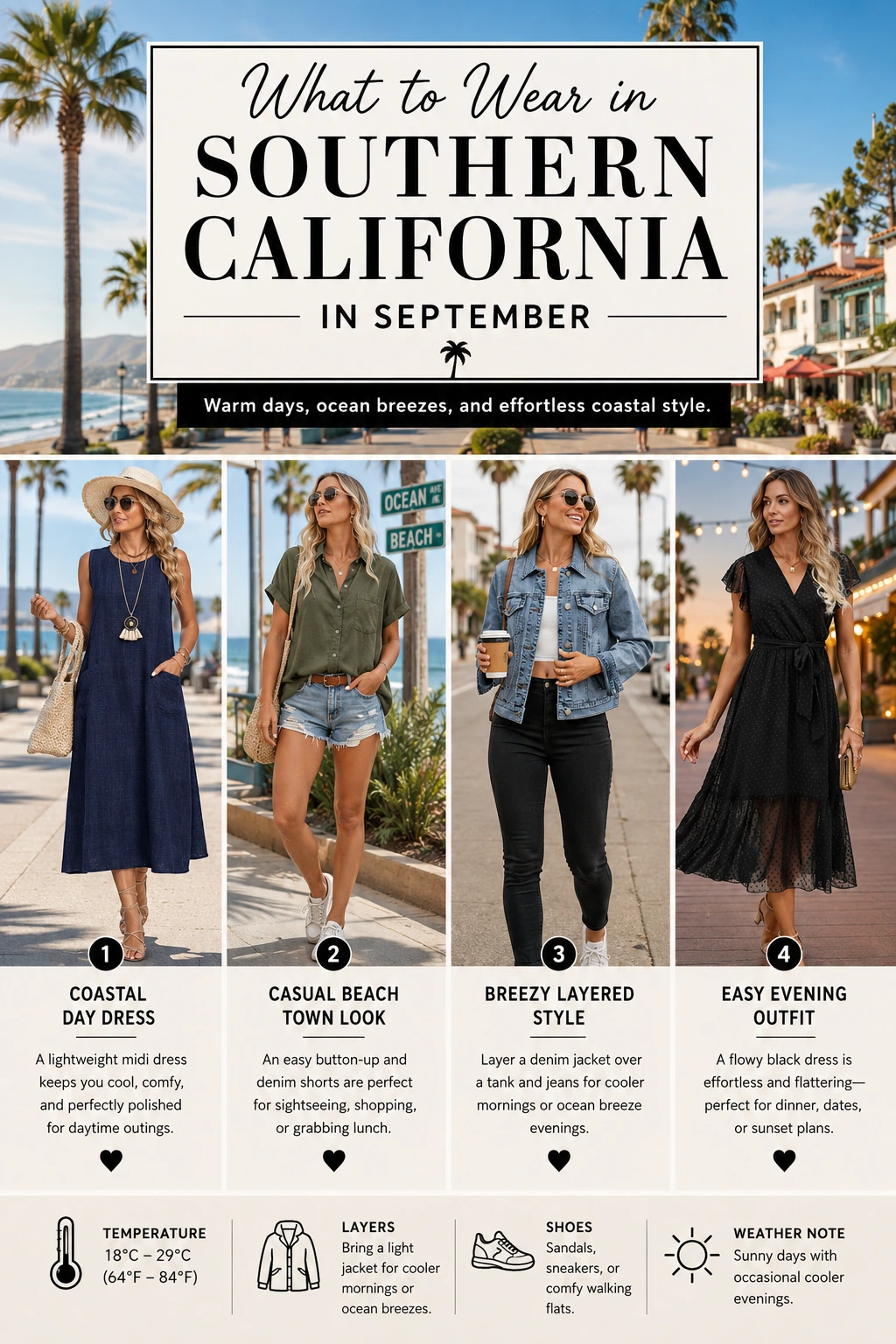
September in Southern California is one of those months that quietly confuses even seasoned travelers. The calendar says early fall, the Instagram photos show golden light and breezy dresses, but the actual weather often behaves more like the height of summer than the start of anything cooler. Coastal towns can feel mild and hazy in the morning, then warm up fast by noon, while inland valleys and desert-adjacent areas swing into genuinely hot territory.
The packing confusion usually comes from treating Southern California as one climate instead of several overlapping ones. A single day trip might move you from a breezy beach boardwalk to an air-conditioned museum to a warm inland dinner patio, each requiring a slightly different outfit logic. Many visitors either overpack for imagined chill or underpack for the sun intensity, and both mistakes are easy to avoid once you understand how the season actually behaves here.
September also sits at the tail end of what locals sometimes call the region’s second summer, when temperatures can climb even higher than in July, especially away from the immediate coastline. That means sun protection and breathable fabrics matter more than a jacket for most itineraries, though evenings still call for a light layer, particularly near the water after sunset.
This guide walks through what the weather really feels like, how to build outfits that move easily between beach, city, and desert-adjacent settings, and how to pack a capsule wardrobe that doesn’t leave you sweating through a museum or shivering on a sunset patio. The goal is a suitcase that works for Santa Monica mornings, Los Angeles gallery afternoons, and a possible detour toward Palm Springs or San Diego, without hauling twice the clothing you’ll actually use.
What the Weather Actually Feels Like in September
Weather: Coastal Southern California in September often sits in the mid-to-high 70s Fahrenheit during the day, with mornings that can feel surprisingly cool and overcast thanks to a marine layer that burns off by late morning. This cloud cover, sometimes called “June gloom” even though it lingers into September in milder years, means a sunny afternoon can start with a genuinely grey, almost chilly hour near the beach.
Inland areas tell a different story. Los Angeles neighborhoods away from the coast, along with desert-adjacent destinations like Palm Springs, regularly push into the 90s or higher during September afternoons, since this is often one of the hottest stretches of the year for interior Southern California. The gap between a coastal morning and an inland afternoon can be twenty degrees or more, which is the single biggest reason layering matters here despite the overall warm reputation.
Evenings bring their own shift. Coastal towns cool down noticeably after sunset as ocean breezes pick up, often dropping into the 60s, while inland areas stay warm well into the night. Humidity is generally low across the region, which makes the heat more tolerable than in muggier climates, though it also means sun exposure feels less obvious until skin starts to burn.
Walking and standing conditions: Terrain varies by destination too. Beach boardwalks and pier areas involve flat, easy walking, but hillier neighborhoods, canyon trails, and some downtown districts require sturdier shoes. Public transportation exists in cities like Los Angeles and San Diego but many itineraries still involve significant walking between parking, attractions, and restaurants, so comfort matters as much as style.
Style culture: Dress expectations across Southern California tend to be relaxed and casual, even at many restaurants and daytime attractions, though beach-casual clothing like swimsuits or flip-flops is generally not worn much beyond the sand and boardwalk itself.
The Layering Logic Behind a Southern California Outfit
The practical compromise for September dressing here is building outfits around a breathable base layer with one easy add-on rather than planning entirely different looks for morning, noon, and night.
A cotton or linen-blend top paired with a light overshirt or cardigan solves most of the coastal morning-to-afternoon swing without requiring a wardrobe change.

Inland days ask for a slightly different approach, since the temperature climb is steeper and the sun stronger. Many travelers do better wearing genuinely lightweight, sun-protective fabrics from the start of the day rather than layering something heavier and removing it later, since inland heat rarely dips low enough to need a jacket until well after dark.

One detail worth knowing is that —indoor air conditioning in Southern California tends to run cold, particularly in museums, shopping centers, and restaurants. A thin layer that can slip into a bag becomes useful not for outdoor chill but for indoor overcooling, which catches a surprising number of visitors off guard on a 90-degree day.
Dresses and One-Piece Outfits for Beach and City Days
A breezy midi or knee-length dress works across more of a Southern California itinerary than almost any other single item, moving from a boardwalk walk to a casual lunch without needing much adjustment. The key is choosing fabric over cut, since a stiff or heavy dress will feel wrong by midafternoon even if the silhouette looks great in photos.

A lightweight linen-blend midi dress handles both coastal humidity-free warmth and inland heat without clinging or wrinkling excessively over a full day of movement. Pair it with slide sandals and a woven tote for a morning market visit, then swap in a thin gold necklace and low sandals for an early dinner without changing the dress itself.

Shorter sundresses suit beach towns and casual boardwalk strolls particularly well, though many visitors find a midi length more versatile for city stops, museum visits, or restaurants with slightly less casual dress norms. A wrap-style dress in a small print hides light travel wrinkles better than a solid pale color, which is a small but useful consideration for anyone living out of a suitcase for a week.

Tops and Breathable Layers That Actually Work
Cotton and linen tops outperform synthetic blends almost everywhere in Southern California during September, simply because they breathe better in dry heat and don’t trap warmth the way polyester often does. A rotation of two or three breathable tops in similar colors makes daily outfit decisions faster, especially on days packed with multiple stops.

A short-sleeve linen button-up shirt works equally well buttoned over a swimsuit at the beach, tucked into shorts for a lunch stop, or worn open over a tank top during an inland afternoon.

Its loose weave helps in both the humid-feeling coastal mornings and the drier inland heat later in the day.

Sleeveless tops and tanks are useful for the hottest inland stretches, though many travelers keep one lightweight long-sleeve option on hand for sun protection during extended outdoor time, since sunburn risk in Southern California’s dry heat is often underestimated compared to more humid climates.

Shorts, Skirts, and Trousers for Warm, Active Days
Shorts remain a practical default for beach towns and casual inland sightseeing, but longer denim shorts or a linen skirt tend to photograph and perform better for city walking days that include restaurants or indoor attractions.

The length matters less than the fabric weight, since anything heavier than a light cotton blend becomes uncomfortable once inland temperatures climb past the mid-80s.

Flowy midi skirts offer a slightly dressier alternative to shorts without sacrificing breathability, and they layer easily with a tucked-in top for dinner.

A pair of wide-leg linen trousers provides sun coverage for desert-adjacent day trips while still feeling cool against the skin, which makes them a smarter choice than jeans for anywhere near Palm Springs or the inland valleys.

Denim shorts or jeans work fine for coastal evenings once the temperature drops, but full denim during a hot inland afternoon is one of the more common discomfort complaints among visitors who packed for a cooler September than the region actually delivers.

Light Jackets and When You’ll Actually Need One
The idea of packing a heavy jacket for Southern California in September is almost always unnecessary, yet many visitors bring one anyway out of habit from other fall destinations. The real need is something thin enough for a breezy evening walk, not something built for cold.
A lightweight denim jacket covers most evening scenarios along the coast, where temperatures can dip into the 60s after sunset even on a hot day. It also doubles as sun protection for shoulders during a long midday walk without adding much bulk to a daypack.

A thin cardigan serves the same purpose for museum visits or restaurants with strong air conditioning, and it folds down small enough to carry all day without noticing the extra weight.

Neither of these should be mistaken for a true jacket meant to handle genuine cold, which this destination rarely produces in September outside of very early desert mornings.
Footwear for Boardwalks, Cities, and Uneven Terrain
Footwear choice probably causes more mid-trip regret than any other packing decision in Southern California, mostly because visitors underestimate how much walking a single day can involve, from parking lots to piers to hillside neighborhoods.

Comfort should outrank style here more than almost anywhere else covered in a typical West Coast itinerary.

A pair of comfortable white leather sneakers works for nearly every daytime scenario, from boardwalk walking to uneven sidewalks in older neighborhoods, and they pair easily with both shorts and casual dresses. They also handle the transition from sandy beach paths to paved city streets better than most sandals.

Flat sandals remain useful for beach days and casual dinners, though anyone planning a day trip involving hills, canyon paths, or extended walking should pack sturdier shoes as a backup.

Flip-flops are fine for the sand itself but tend to be impractical once the day moves beyond the immediate beach area.

Evening Outfits for Coastal Cool-Downs and City Dinners
Evenings along the coast bring a noticeable temperature drop that catches visitors off guard after a warm afternoon, which is why an evening outfit here often needs one more layer than the daytime version rather than a completely different look. Inland evenings stay warmer, so the same outfit formula doesn’t always transfer between destinations on a single trip.
A midi wrap dress transitions easily from a beach-town dinner to a slightly dressier restaurant in a city like Los Angeles or San Diego, especially when paired with low block-heel sandals instead of flats. Adding the lightweight denim jacket mentioned earlier turns the same dress into a comfortable outfit for an oceanfront evening walk once the breeze picks up.

For inland evenings, particularly around Palm Springs, breathable trousers or a linen jumpsuit tend to feel more comfortable than a dress requiring an added layer, since the warmth often lingers well past sunset. Many visitors find one adaptable evening outfit is enough for a week-long trip, since restaurants across the region tend to favor relaxed dress codes over formal ones.

Museum, Restaurant, and Indoor Dress Considerations
Most museums, galleries, and restaurants throughout Southern California maintain a casual-to-smart-casual atmosphere, without strict dress codes for daytime visits.
A clean, put-together version of daytime clothing, rather than beachwear, is usually sufficient for stepping into most indoor cultural spaces.
A small number of upscale restaurants, particularly in parts of Los Angeles or coastal towns like Santa Barbara, lean slightly dressier in the evening, so packing one outfit a notch above resort-casual is a reasonable precaution rather than a strict requirement. Swimsuits, visible beachwear, or flip-flops are generally not worn inside museums or sit-down restaurants, even in the most laid-back beach communities.
Bags That Handle Beach Days and City Errands Alike
A single do-everything bag saves significant packing space, but it needs to handle sand, sun, and occasional city errands without falling apart by day three. Structure and strap comfort matter more than size for most Southern California itineraries.

A crossbody bag with an adjustable strap keeps hands free during boardwalk walks, farmers markets, and public transit connections in cities like San Diego or Los Angeles, while sitting close enough to the body to feel secure in busier tourist areas.

A separate lightweight tote works well as a beach-day companion, easily holding a towel, sunscreen, and a water bottle without the structure needed for city use.

Sun Protection That Actually Matches the Climate
Southern California’s dry, low-humidity heat can disguise how strong the sun actually is, which is why sun protection deserves more attention here than the mild temperatures might suggest. This is where many travelers underprepare, assuming humidity is the main risk factor rather than direct UV exposure.
A wide-brim sun hat protects the face and neck during long outdoor stretches, whether that’s a beach afternoon or a walking tour through an open-air market. It also reduces the need to reapply sunscreen to the scalp and hairline as frequently.

Polarized sunglasses cut glare significantly along the coast, where sunlight reflecting off the ocean can be more intense than the temperature alone suggests. Inland and desert-adjacent areas bring their own glare from pale rock and sand, making sunglasses one of the more consistently useful items across the entire trip.

A reef-safe sunscreen stick offers an easy reapplication option for exposed areas like the nose, ears, and shoulders without the mess of traditional lotion, which is particularly useful during a beach day or extended outdoor sightseeing.

Fabrics Worth Packing and Ones to Avoid
Breathable natural fibers consistently outperform synthetics in Southern California’s dry September heat. Linen, cotton, and lightweight rayon blends handle both the coastal humidity-free warmth and the drier inland heat without holding odor or trapping heat the way polyester often does over a long day.
Heavier fabrics like thick denim, wool, or fleece rarely earn their space in a suitcase for this destination and season, since even the coolest evenings along the coast rarely require more than a thin layer. The practical rule many travelers settle on is packing for genuine summer heat with one thin layer added for evening breezes, rather than planning around fall-weight clothing that this region simply doesn’t need in September.
Common Clothing Mistakes to Avoid
One of the most common mistakes is packing as though September in Southern California will feel autumnal, leading to unused sweaters and jackets that take up suitcase space without ever being worn. The region’s fall weather pattern typically arrives later in the year, particularly inland.
Another frequent misstep is underestimating inland heat when planning day trips toward Palm Springs or other desert-adjacent areas, since coastal mildness doesn’t extend far past the immediate shoreline. A third mistake is prioritizing sandals over supportive walking shoes, which becomes uncomfortable quickly on longer city days or hillier neighborhoods. Finally, many visitors skip sun protection items because the temperature doesn’t feel extreme, forgetting that dry heat and strong UV exposure can cause sunburn faster than more humid climates with similar temperatures.
Building a Practical Capsule Wardrobe
A workable capsule for a week in Southern California usually includes two lightweight dresses, three breathable tops, one pair of shorts, one pair of linen trousers or a skirt, one thin jacket or cardigan, and two pairs of shoes, one for walking and one for evenings. This kind of limited rotation is similar in spirit to capsule strategies used for other September destinations, including approaches outlined in guides like what to wear in New York in September or what to wear in Miami in September, though the specific fabric and layering choices shift based on humidity and heat intensity.
Color coordination around two or three complementary tones makes mixing and matching faster each morning, and it also reduces the temptation to overpack “just in case” items that rarely get worn. Anyone planning a broader West Coast or cross-country itinerary might find it useful to compare regional differences, similar to how a guide on what to wear in Dallas Texas in September addresses a different kind of inland heat.
Packing for a One-Week Southern California Trip
For an example one-week trip, a reasonable packing list includes four to five tops, two dresses, two bottoms beyond the dresses, one light jacket or cardigan, two pairs of shoes, and a swimsuit if a beach stop is planned. This allows for outfit repetition without anyone noticing, since mixing tops and bottoms across different days creates enough visual variety.
Laundry access, whether through a hotel service or a laundromat, makes packing lighter more realistic for longer stays, and many travelers find that rewearing breathable fabrics like linen and cotton causes little noticeable wear compared to synthetic blends. Packing light also simplifies moving between destinations if the itinerary includes multiple stops, such as a coastal city followed by an inland detour.
What to Wear on Travel and Transition Days
Travel days benefit from an outfit that handles airport air conditioning, car time, and possible temperature swings between departure and arrival cities. Loose trousers or a midi dress paired with the lightweight jacket mentioned earlier covers most scenarios without requiring a change immediately upon arrival.
Comfortable slip-on shoes make security lines and long car rides easier, and a scarf or light wrap can double as a blanket during a flight with strong air conditioning. This same layering logic applies whether the itinerary includes a stop in Toronto beforehand or a direct flight straight into Los Angeles.
Adjusting the List for Coastal, City, or Desert-Adjacent Stops
A trip weighted toward coastal towns like Santa Monica or San Diego can lean slightly more on breezy dresses and a jacket for evening chill, while a trip that includes Palm Springs or other desert-adjacent stops should prioritize sun protection and the lightest possible fabrics, since afternoon heat there regularly exceeds coastal temperatures by a wide margin. City-heavy itineraries in Los Angeles benefit from one slightly dressier outfit for evening dining, alongside comfortable shoes for genuinely long walking days between neighborhoods and attractions.
September in Southern California rewards travelers who pack for real heat and real sun rather than an imagined autumn chill. A handful of breathable dresses, one dependable jacket, sturdy walking shoes, and serious sun protection will carry a traveler comfortably from a foggy beach morning to a warm desert afternoon to a breezy coastal dinner, without a suitcase full of unused layers. The most useful mindset is treating this as a summer wardrobe with a single light layer added for evenings, and letting the region’s dry, sunny character guide every packing decision from there.


4 Responses